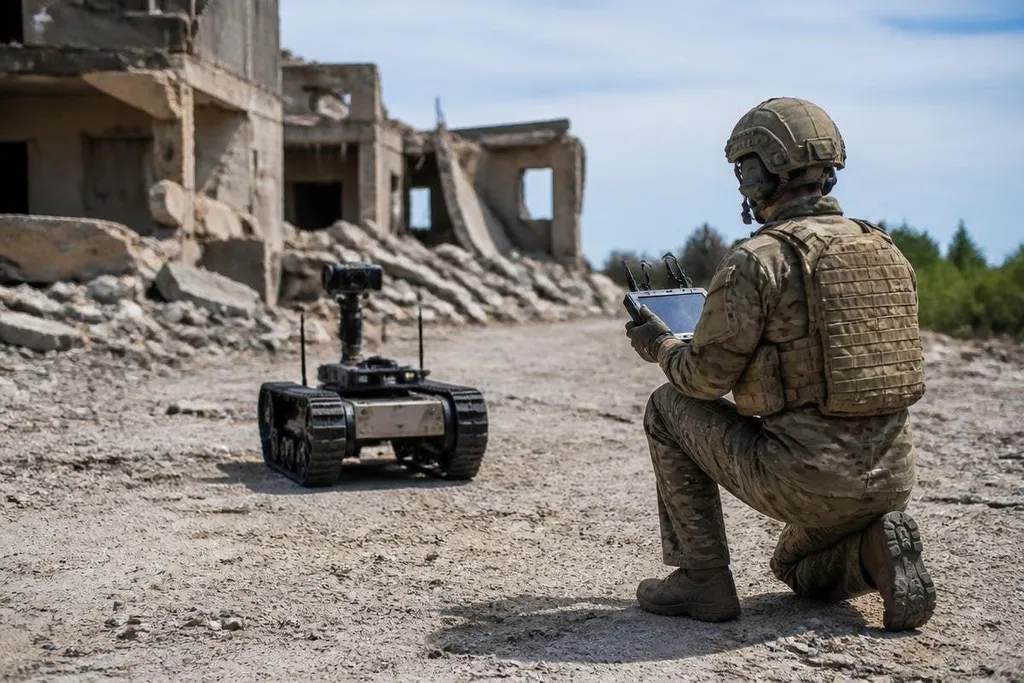
Military robots matter most when a task puts people in danger, takes too long, or needs a view from a place they can't safely reach. The case for them rests on clear jobs: watching, carrying, finding hazards, and moving through areas that may contain mines or other threats.
- Robots can keep people farther from immediate danger.
- Sensors give operators a view from ground, air, or sea.
- Remote control still matters when autonomy cannot be trusted.
The jobs robots can take on
A ground robot fitted with cameras can inspect a route before a person walks it. A small aerial system can look over a ridge or building. An underwater robot can check a pier or hull without sending a diver into unknown water.
The hardware changes with the task. Tracks help a ground robot cross loose soil, while wheels suit firm roads and supply routes.
A thermal camera can show heat in darkness, while LiDAR measures distance with laser pulses. These parts are useful because they turn a dangerous space into information an operator can review from a safer position.
Carrying work matters too. The robot can move water, batteries, medical supplies, or equipment across a site. That can reduce the number of trips made by people, but the robot still needs a route, a working radio link, and enough battery power to return.
Why remote control still matters
Military work often takes place in conditions that are hard to predict. Smoke can block cameras. Dust can confuse sensors. A damaged radio link can leave a robot unable to receive new commands.
That makes teleoperation important. In teleoperation, a person sends commands while watching video and sensor data from a distance. The robot handles movement, but the operator decides what the machine should do next.
Autonomy can help with narrow tasks, such as holding a route, avoiding an object, or returning to a known point. It does not remove the need for human judgment when the scene changes or the cost of a mistake is high.
A route-holding robot still needs a person when its map no longer matches the ground. Robot24.com military robotics coverage can connect the system’s task to its test setting, control link, and stated limits before the next section examines where autonomy fails.
The hard limits
The system is only as useful as its complete setup. That includes the vehicle, sensors, control software, batteries, spare parts, radio network, and trained operators. A failure in any one part can stop the task.
Weather also matters. Rain can reduce camera quality. Cold can cut battery output. Rough ground can damage wheels, tracks, or sensor mounts. A robot that works on a clean test route may behave differently after hours of dust, vibration, and repeated impacts.
The operator's workload is another limit. One person may control one machine during a complex task. If a system needs constant attention, the force may gain a robot but lose the person who could have handled another job.
The largest unanswered issue is trust. A unit needs clear rules for when a robot may move, stop, report a target, or use force. Those rules depend on the system's sensors, software, communications, and the people responsible for each decision.
A practical buying checklist
Before judging a military robot, check these points:
- Name the task: route inspection, supply carrying, surveillance, or hazard removal.
- Check control: record the radio range, delay, backup link, and behavior after signal loss.
- Test the sensors: compare day, night, dust, smoke, rain, and low-light performance.
- Measure the burden: include batteries, chargers, spare parts, transport cases, and operator training.
- Set the human rule: state which actions need a person to approve them.
- Record recovery: test how the team finds, moves, repairs, or abandons a disabled robot.
These checks turn a broad claim into a job-specific decision. A robot may be useful for route checks and still be a poor choice for long supply runs if its battery, radio link, or repair plan falls short.
What happens next
Military robots will gain ground where they can do one defined job with less risk and less operator strain. The systems that last will be the ones with clear limits, repair plans, and tests that match the places where they must work; the open question is how many can stay useful after the first damaged sensor or lost radio link.